Claves Angelicæ
Details
- Year: 2018
- Timestamp: 1532572562435
- Artist: Gabriel Dunne
- Artist: Cullen Miller
- Medium: Installation
- Exhibition: Distributed Systems
- Exhibition: Ethereal Summit
Description
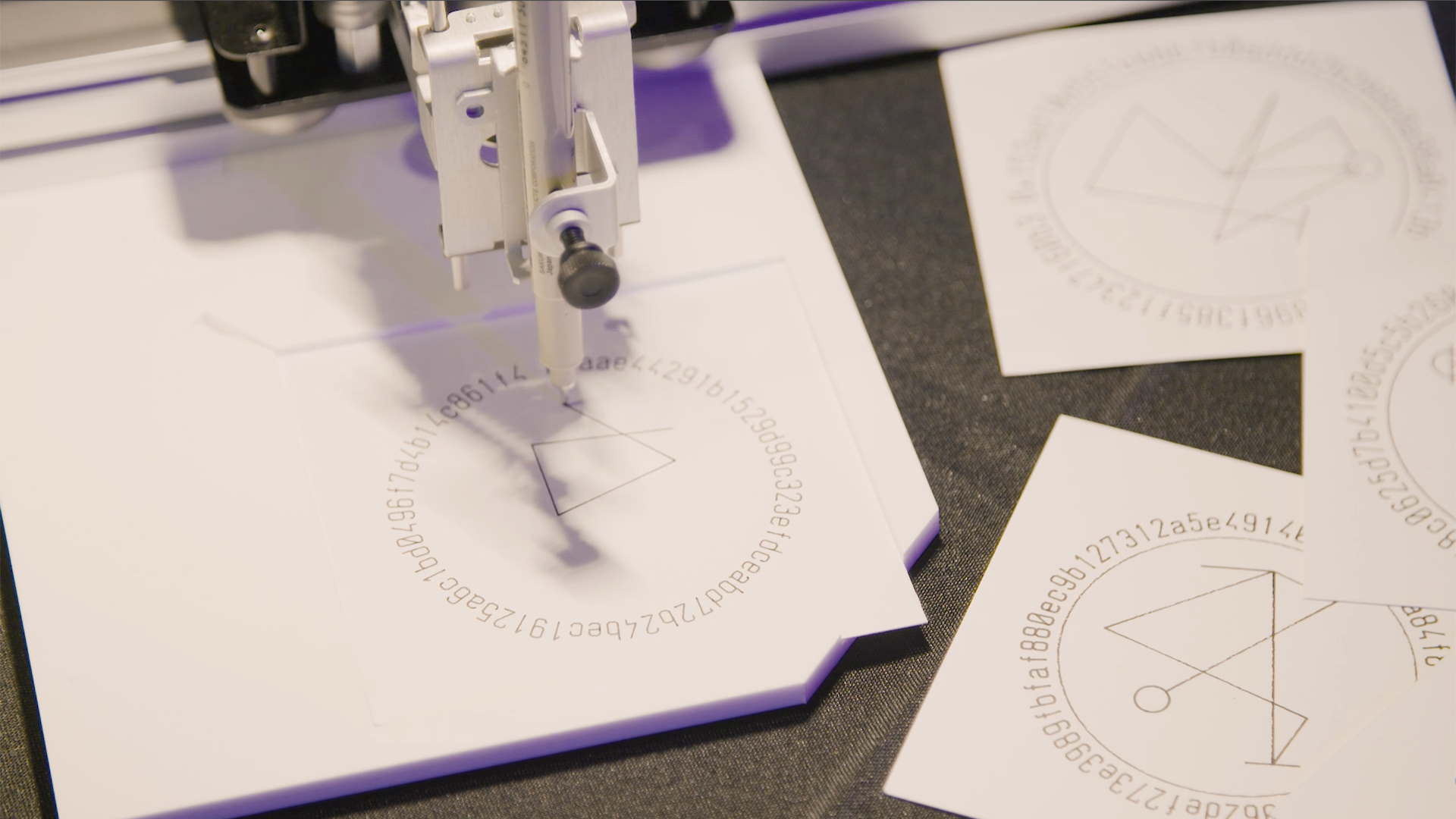
Claves Angelicæ is an installation and procedural system that enables a participant to inscribe a magical Word onto the Ethereum network.
The seven step process is designed to collect and transmute the participants’ input data into an encrypted message. For the participant to cast their Word they must transmit Ether to a preselected set of charities. Once the spell has been cast and verified by the consensus pool, the transaction signature’s hash is returned, parsed, and passed into a sigil generating algorithm. The participant receives an inked paper talisman authored by a mechanical drawing machine as a tokenized sigil of their spell.
Cryptography and magic have a deep, intertwined history dating back to the origins of writing. During the European dark ages monastic sects bore the responsibility of keeping the rites of the sacred ancient mystery cults of Egypt and Greece intact. However, in doing so they ran the risk of being burned at the stake for committing crimes of heresy. Some of them developed cryptographic systems to encode these secrets into their manuscripts. It was not only the monks working with ciphers but also natural magicians and occultists. The latter groups weren’t only using cryptography to obfuscate sensitive information, but also to devise keys and linguistic frameworks for communicating into the Ethereal realms. By devising new linguistic schemata these magicians believed that they could access the preternatural realms outside the worlds they were exploring in their scientific pursuits. Although the blockchain space is largely secularized, the principles of the Ethereum network is a manifest dream of the ancient magi. Magicians are the original cipherpunks. Solidity, Serpent, and LLL are grimoires (Latin ‘grammaire’) or books of magical grammar. Smart contracts are daemons invoked to enact our Will. DAOs (Decentralized Autonomous Organizations) are archons governing and managing resources from the Ether. Pentacles are cryptographic tokens for binding daemons and storing value. Magical codes of ethics are emblematized in protocol authorship. Salt, one of the alchemical primes, is also used in cryptography where it serves as random data that is used as an additional input to a one-way function that ‘hashes’ the Word. Sigils are graphical databases used for storing enciphered information.
For common parlance let’s define what a sigil is: the encoding of desire or intent into a symbol. The Latin sigillum, means ‘seal’, though it may also be related to the Hebrew הלוגס (segula meaning ‘word, action, or talisman’). A few examples of sigils are Johannes Trithemius’ experiments in ‘Steganographia’, Giordano Bruno’s mnemonic devices, and John Dee’s Sigillum Dei Aemaeth.
Centralized authorities and trusted-third parties (churches & banks) shape our cultures into monotheistic tendencies (e.g. “In God We Trust”) where priests or bankers arbitrate and broker access to the value system. Whereas decentralized systems allow for a plurality of deities to inhabit the Ether and entrust magicians to enact their Will without intermediation.
Exhibitions
- Distributed Systems, Gray Area Foundation for the Arts, San Francisco, 2018 (US)
- Ethereal Summit, Knockdown Center, Brooklyn NY, 2018 (US)